Free shipping, no minimum · 30-day guarantee · Made in Orange, California
The Apartment Cup Holder.com ← back to the apartment page

The apartment file

Why drinks tip in a small apartment — and what actually holds them steady

A rented apartment doesn't lack surfaces for a drink — it lacks a stable one. Every square foot pulling double duty means the nearest flat spot to your hand was built for something else, and the physics of tipping run differently here than they do in a house with room to spare for a proper side table.

How small the room actually is

The average new US apartment runs about 908 square feet, and that number splits sharply by unit type: a studio averages around 457 square feet, a one-bedroom about 735. A side table that would go unnoticed in a house eats a real percentage of a room that size, which is why furniture makers built an entire product category — the "apartment-size sofa," typically 68 to 80 inches long against 84-plus inches for a standard three-seater — specifically to claw back floor space in a small living room.

Most of those saved inches come off the arms. A rounded, pillow-topped, or simply narrower arm is a direct trade for a few more inches of walkable floor, and it's also the surface that used to hold a drink. Cup holder buying guides put the stability threshold at roughly 6 inches of flat arm width for clip-on gear — under that, trays and clamp holders wobble. Apartment-size arms routinely land under it by design, not by accident.

The physics of a narrow, tall container

Tipping is a leverage problem before it's anything else: the higher a container's center of gravity sits relative to the width of its base, the less force it takes to push it past the point of no return. This is where the drinks people actually reach for in an apartment work against them. A 12 oz "sleek" can — the shape most hard seltzer ships in — is about 2.25 inches across and 6.14 inches tall, noticeably narrower and more than an inch taller than a standard 12 oz can at 2.60 by 4.83 inches. Cans get shaped that way for the shelf, not the coffee table, and the height-to-width ratio that looks good in a cooler is the same ratio that tips over with less of a nudge.

Then the apartment adds a second variable most kitchens don't have to deal with: a surface that isn't flat to begin with. A cushion or a duvet doesn't just sit there — it compresses unevenly the moment weight goes on it, so the base is already tilted before anyone bumps anything. A balcony slab is worse in a specific, permanent way: it's poured with a drainage slope of about a quarter inch per foot, roughly a 2 percent grade, so no spot on it is level by design, not by wear. A tall, narrow can on a surface that starts tilted needs less of a push to go over than the same can on a flat kitchen counter — the two problems compound instead of adding.

Why the stakes are different when the floor isn't yours

The same spill means two different things depending on whose floor it lands on. In a house, wine on the rug is a cleaning problem. In a rental, it's frequently a line item: landlord and property-management deposit guidance consistently treats drink stains on carpet as tenant damage, distinct from the normal wear a lease is supposed to absorb. That distinction is exactly why the default apartment drink spot — the floor beside the couch, ankle height, in the walking lane — is the worst possible place for the accident to happen. It's rented ground, and it remembers.

Wondering about your specific cup? The fit database has sourced base measurements for 30+ containers — Stanley, Red Bull, Yeti, and the honest no's.

What people try, and where each one runs into the room's own limits

The fixes people reach for first all share one assumption: that there's a flat, rigid, correctly sized surface to attach to. A clip-on or bamboo arm tray needs a specific band of arm width and a hard edge to grip — exactly what an apartment-size sofa's rounded, pillow-topped arm doesn't offer, which is why reviewers of that category report constant re-leveling and wobble as the norm rather than the exception. A fabric armrest caddy solves the mounting problem by going soft instead of rigid, but that just moves the failure: a full water bottle in the cup pocket tips the whole caddy, and when a drink does go over, it's held against the exact stretch of couch fabric it's about to stain.

A C-shaped side table sidesteps the mounting question entirely by being furniture, which means it runs into the room's actual problem — no spare floor — before it runs into any question of stability, and its casters still fight carpet pile once it's in place. A balcony railing holder bets on one specific railing thickness and profile before it even ships, and the screw-mounted versions were never an option on a landlord's railing to begin with. And a coaster, whatever surface it's on, only ever answers the ring left behind — it does nothing about the tilt of a cushion, a duvet, carpet pile, or a sloped slab, which is where apartment drinks are actually sitting when they go over.

What actually works on ground you don't get to level

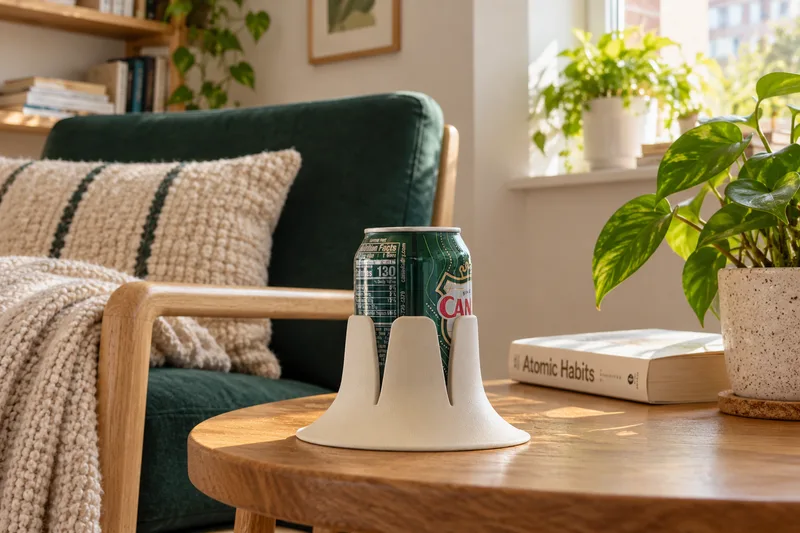
Fixing this in an apartment means solving for surfaces that move and slope rather than a surface that's flat and fixed — which rules out anything that depends on clamping to one arm width or one railing profile. What holds up instead is a footprint wide enough to spread across a compressible or sloped surface instead of concentrating weight at one point, paired with a grip that acts on the container itself rather than the surface under it. A wide, flexible base spreads across a cushion or a duvet the way a narrow can't; fins that hold the container by its bottom inch — where the leverage math above is decided — keep a bumped drink seated instead of loose; and a base that flexes with whatever it's resting on re-levels itself when the cushion re-tilts or the slab's permanent slope reasserts itself. The fit range that makes this work in practice runs 2 to 3 inches across the container's base, with the fins able to flex to about 3.15 inches for a snug seat on wider bases — under 2 inches sits too loose in the fins, and there's a ceiling here as well as a floor.

None of this is exotic engineering — it's matching the object to the ground it actually has to work on. A base that spreads instead of a leg that points, and a grip on the drink instead of a clamp on the furniture, resists tipping on ground nobody built to be level in the first place.

Get yours — free shipping

You'll finish at steadilabs.com — Steadi Labs is the manufacturer.